Sheeting Line
Multi-head Pastry Pancake Forming Line
The multi-head pastry forming line runs 20,000-60,000 pcs/h at 1.5-2.0 t/h, shaping croissants and Danish from 30-350 g pieces on a 680-1280 mm working width. Forming is by dough belt and encrusting cutter, with proofing, oven and cooling as options. 65 kW, 380V or 220V, 304 stainless steel.
Product Overview
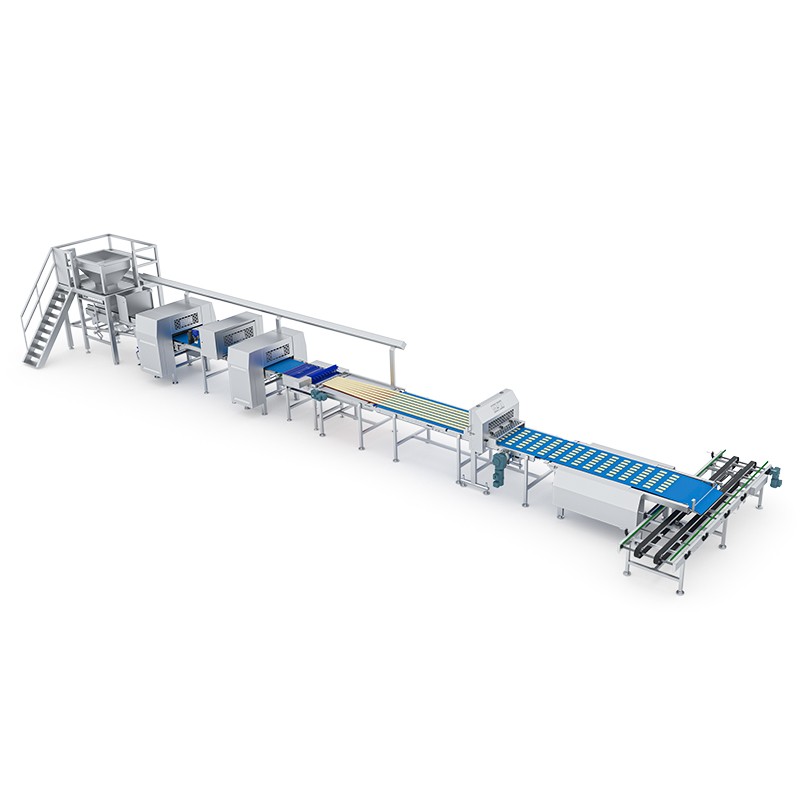
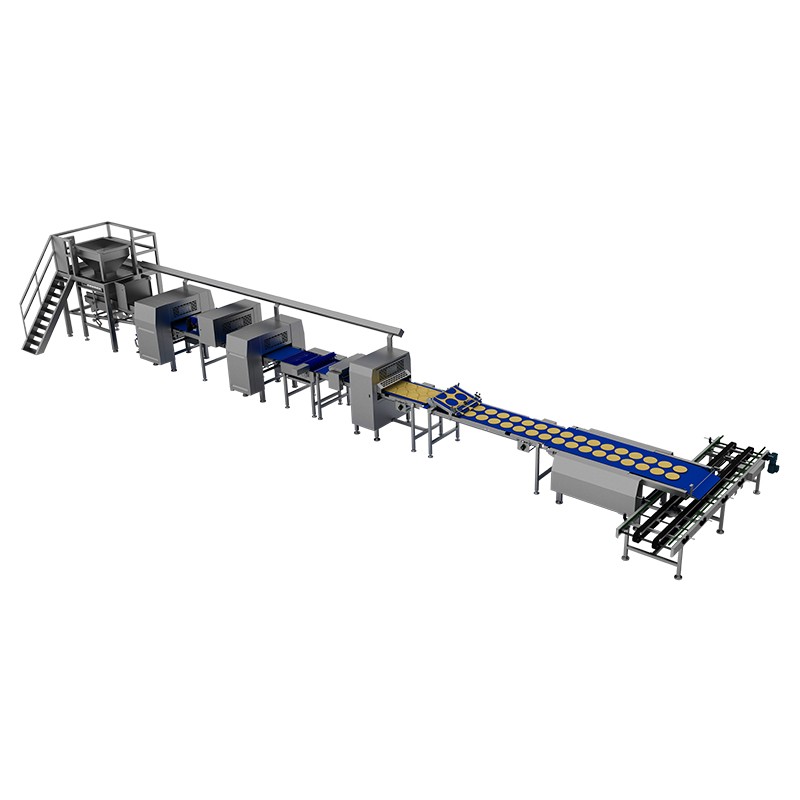
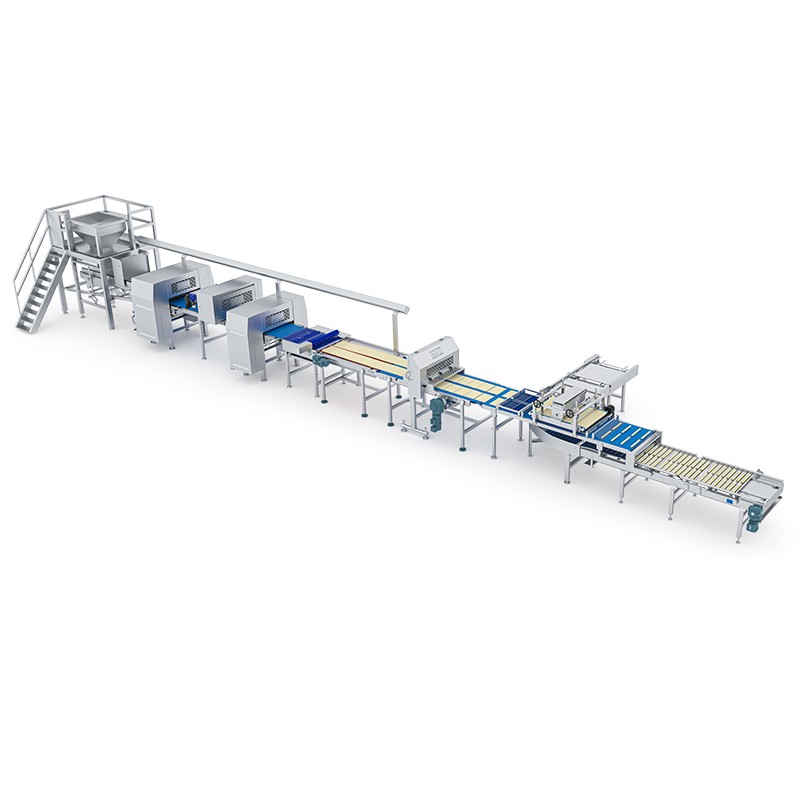
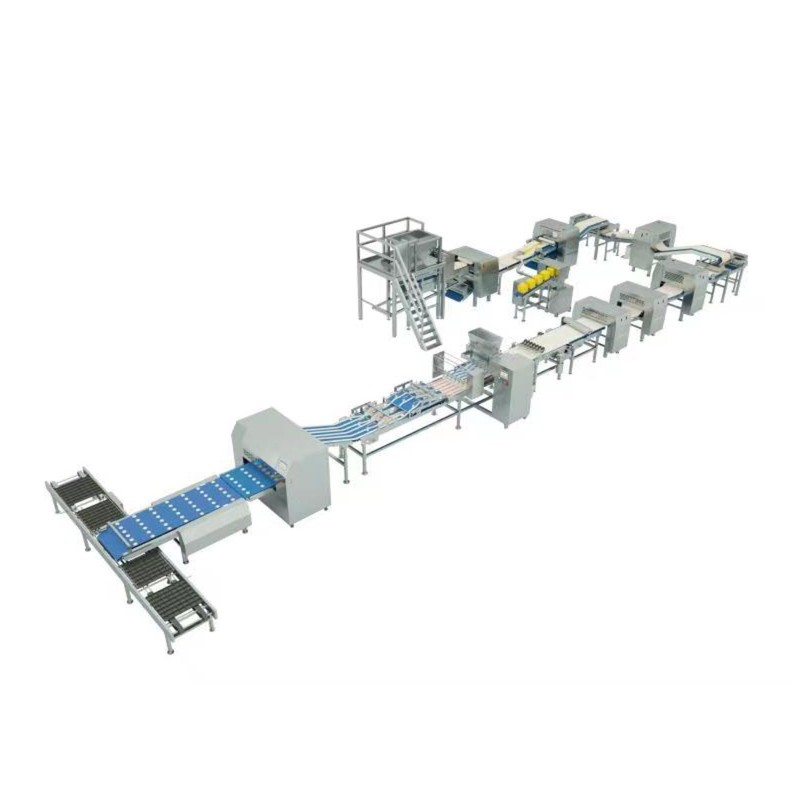
The multi head pastry forming line is a full automatic pastry production line in the Bread & Pastry Lines category. It combines dough sheeting and forming with a multi-head depositor, and it is built for large industrial food factories that need a consistent pastry shape at volume. The line runs 20,000–60,000 pieces per hour, is constructed in 304 stainless steel, and takes 380V/220V power at 65KW.
Shape consistency comes from dough belt forming and an encrusting cutter, not from hand work. Product size runs 25mm–120mm and product weight 30–350g, both set to the order. The line can be connected to a proofing machine, and an oven and cooling section can be added, so a bakery can move from mixed dough to packed pastry on one continuous flow.
Key Features
- Multi-head depositor: deposits product after product on a continuous line, so output does not stop between cycles.
- Dough belt forming system: low-stress processing keeps the dough belt structure intact and the dough softer.
- Encrusting cutter: fixes the pastry shape, which is how the line holds a consistent profile across a long run.
- Capacity range of 20,000–60,000 pcs/h: one line covers trial volumes and full industrial output.
- 304 stainless steel construction: the food-contact surfaces and frame are built for washdown and long service.
- Dough resting and cooling tunnel: relaxes the belt to each customer’s process, with an anti-condensation device so the dough does not dry or crack.
- Fat pump and satellite rolling tower: lays a uniform grease band of set width and thickness, with no fat accumulation.
- Tray arrangement device: places products according to your tray size, and can place products across trays.
Product Specifications
| Model | Multi-head Pastry Pancake Forming Line |
|---|---|
| Category | Bread & Pastry Lines |
| Capacity | 20,000–60,000 pcs per hour |
| Equipment capacity | 1.5t–2.0t/h |
| Product size | 25mm–120mm, set to product requirements |
| Product weight | 30g–350g, set to product requirements |
| Equipment power | 65KW |
| Equipment voltage | 380V/220V |
| Equipment dimensions | 30000*8000*2500MM |
| Equipment weight | 5560kg |
| Equipment material | 304 stainless steel |
| Working width | 680–1280mm, selected to capacity requirement |
| Laminating width | 600–1200mm working width |
| Forming method | dough belt forming with encrusting cutter |
| Options | proofing machine connection, oven, cooling section |
| Full specifications | available on request as a multi head pastry forming line datasheet, and we can quote a pancake forming machine for sale against your product size and hourly target |
Configurations & Options
| Standard line with multi-head depositor | the base configuration for continuous pastry and pancake production. |
|---|---|
| With proofing machine connection | links forming to proofing for a full automatic process. |
| With oven and cooling | turns the line into a turn-key solution from dough to cooled product. |
| Working width 680–1280mm | choose the width that matches your hourly capacity target. |
| Laminating system, asymmetric folding | suits soft doughs such as Danish pastry. |
| Laminating system, cutting and stacking | lays even or uneven layers and suits soft and biscuit doughs. |
| Tray arrangement | set to your tray size, with cross-tray placement where needed. |
| Voltage 380V/220V | specify the plant supply when ordering. |
Industrial Applications
- Pastry forming machine for croissant production: industrial bakeries running laminated dough at volume use the dough belt forming and encrusting cutter to keep croissant shape consistent across 20,000–60,000 pcs/h. The problem it solves is shape drift between shifts: the cutter geometry, not the operator, sets the profile.
- Multi head depositor for Danish pastry: the asymmetric folding system handles soft Danish dough, and the low-temperature relaxation tunnel keeps the belt from drying or cracking before depositing. Without the relaxation stage, soft dough tears at the depositor and the fold line opens during baking.
- Pastry forming machine for industrial bakery: large food factories connect the line to a proofing machine and add oven and cooling for a continuous process from mixed dough to packed product. The line runs at 1.5t–2.0t/h equipment capacity with a 680–1280mm working width, so throughput is set by the forming section rather than by manual transfer between stations.
- Pancake forming machine for laminated dough: the fat pump lays a uniform grease band and the satellite rolling tower rolls it in, giving repeatable lamination for pancake and pastry products. Uniform fat distribution is what prevents layer merging and uneven lift in the baked product.
- Pastry forming machine for filled and rolled products: the separator belt cuts the sheet into narrow belts for filling, and the rolling-to-cylinder mechanism forms ramen bags, chocolate bags and filled rolls. Cutting and rolling happen in one pass, so filling weight stays consistent across the run.
- Laboratory and pilot-plant trials: R&D teams testing a new laminated dough or filling recipe run small batches on the same forming head geometry used in production, so a formula proven on the pilot unit transfers to the full line without re-tuning the cutter or folding system.
- Flour and ingredient suppliers: technical service staff forming sample sheets from customer flour lots check dough extensibility and lamination behaviour on the line before recommending a flour grade to a bakery. The test shows how a specific lot behaves at production working width, not just in a lab mixer.
Key Advantages
- Shape consistency is mechanical, not operator-dependent: dough belt forming plus the encrusting cutter holds the pastry profile across a full shift. A 20,000–60,000 pcs/h line depends on that repeatability.
- The low-stress dough handling protects the belt structure, so laminated products keep their layers and the finished pastry stays softer after baking.
- A 1.5t–2.0t/h equipment capacity matches the line to industrial output, and the 680–1280mm working width lets you size it to your actual volume instead of overbuying.
- One supplier covers forming, proofing, oven and cooling, so the interfaces between sections are settled before the line ships.
- The 304 stainless steel build and continuous dough sheet production reduce stoppages for cleaning and belt damage over years of running.
How to Choose the Right Configuration
| Standard forming line with multi-head depositor | factories that already have proofing, baking and cooling and need the forming stage at 20,000–60,000 pcs/h. |
|---|---|
| Line with proofing machine connection | bakeries that want the dough to move from forming to proofing without manual transfer. |
| Line with oven and cooling | new plants or expansions that want a turn-key process from mixed dough to cooled pastry. |
| 680–1280mm working width | choose the lower end for a single-product line, the upper end when capacity targets approach 60,000 pcs/h. |
| Asymmetric folding | soft doughs such as Danish pastry, where gentle lamination matters more than layer count. |
| Cutting and stacking | soft doughs and biscuit doughs that need even or uneven layers with a working width from 600 to 1200mm. |
Why Choose Us
We quote the multi head pastry forming line configuration that fits your product size, weight and hourly target, not a fixed catalogue model. Our engineers work from your tray size and capacity demand when they specify the tray arrangement and working width.
- We build the line in 304 stainless steel and can carry out upgrading and transformation to an existing line according to your requirement.
- Spare parts and technical support are handled by the same team that specifies the line, so the answer comes from someone who knows the machine.
- We quote a multi head pastry forming line price against a defined configuration, so the offer is comparable line to line.
- We ship direct from the plant and handle export packing and documents for overseas orders.
- OEM and ODM requests are reviewed against the drawing before quotation.
Factory Strength
The line is built in-house, from the stainless steel frame and dough belt forming section to the fat pump, satellite rolling tower, folding system and tray arrangement device. Assembly and run-in happen before packing, and each unit is checked against the ordered product size, weight and capacity. We supply industrial food factories and export the line with the forming, proofing, oven and cooling sections matched to one process. Upgrading and transformation of existing pastry lines is part of the work, carried out to the customer's requirement.
Quality Control
Incoming 304 stainless steel and bought-in components are checked against the order before assembly. In-process checks follow the forming section, the fat pump and the folding system, where belt alignment and grease width decide product quality. A final run confirms product size, weight and output against the agreed specification.
- Material check on stainless steel and food-contact parts at goods-in.
- In-process inspection of dough belt tracking, fat band width and fold pattern.
- Final run test at the ordered product size, weight and capacity.
- Line records kept against the order for traceability.
Packaging & Delivery
The line is packed for export in sections, with the forming, depositing and tray arrangement units protected separately for container loading. The 30000*8000*2500MM footprint means loading is planned per order. Lead time and trade terms are confirmed with the quotation, and the buyer supplies the deposit, import documents and shipping marks.
- Sectional export packing matched to the container plan.
- Loading plan issued before shipment.
- Shipping documents prepared to the buyer’s import requirements.
- Lead time confirmed at order, against the agreed configuration.
FAQ
What is the capacity of the multi head pastry forming line?
The line runs 20,000–60,000 pieces per hour, with an equipment capacity of 1.5t–2.0t/h. The exact figure depends on product size and weight, which run 25mm–120mm and 30–350g.
How does the multi head depositor keep the pastry shape consistent?
Shape is set by dough belt forming and the encrusting cutter rather than by operator handling. The depositor then places product after product on the continuous line, so the profile holds across a long run.
Can I get the multi head pastry forming line specifications and a datasheet?
Yes. The specifications above cover capacity, power, dimensions, weight and material, and we issue a multi head pastry forming line datasheet against your product size and weight.
Can the line run croissant and Danish pastry?
Yes. Pastry forming machine for croissant production and multi head depositor for Danish pastry are both within the product range, along with mesh pasty bread. The asymmetric folding system is the one usually specified for soft Danish dough.
What doughs can the folding system handle?
The asymmetric folding system suits all kinds of dough but is mainly used for soft doughs such as Danish pastry. The cutting and stacking system suits soft doughs and biscuit doughs, with a working width from 600 to 1200mm.
What is the multi head pastry forming line price?
Price depends on the configuration: working width, folding system, tray arrangement, and whether proofing, oven and cooling are included. Send your product size, weight and hourly target and we will quote a defined configuration.
What is your MOQ and lead time?
The line is built to order, so MOQ and lead time are confirmed with the quotation against the agreed configuration. Both are stated in the offer before the order is placed.
Do you offer OEM and can the line be modified for our plant?
Yes. We carry out upgrading and transformation according to the customer's requirement, and OEM requests are reviewed against the drawing before quotation.
How is the line packed and shipped?
It is packed in sections for export container loading, with a loading plan issued before shipment. Shipping documents are prepared to your import requirements, and trade terms are confirmed with the quotation.