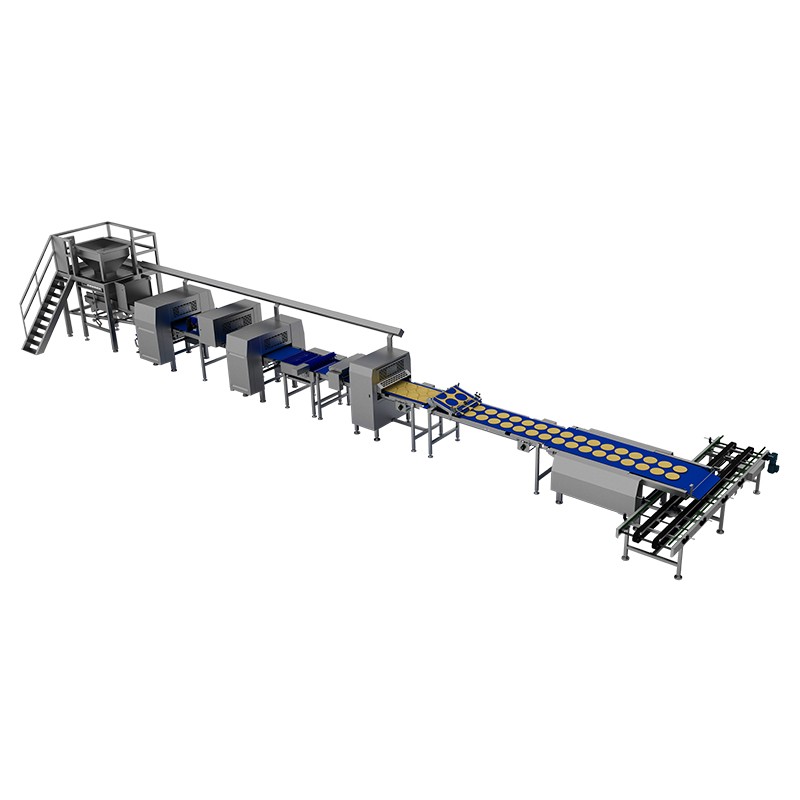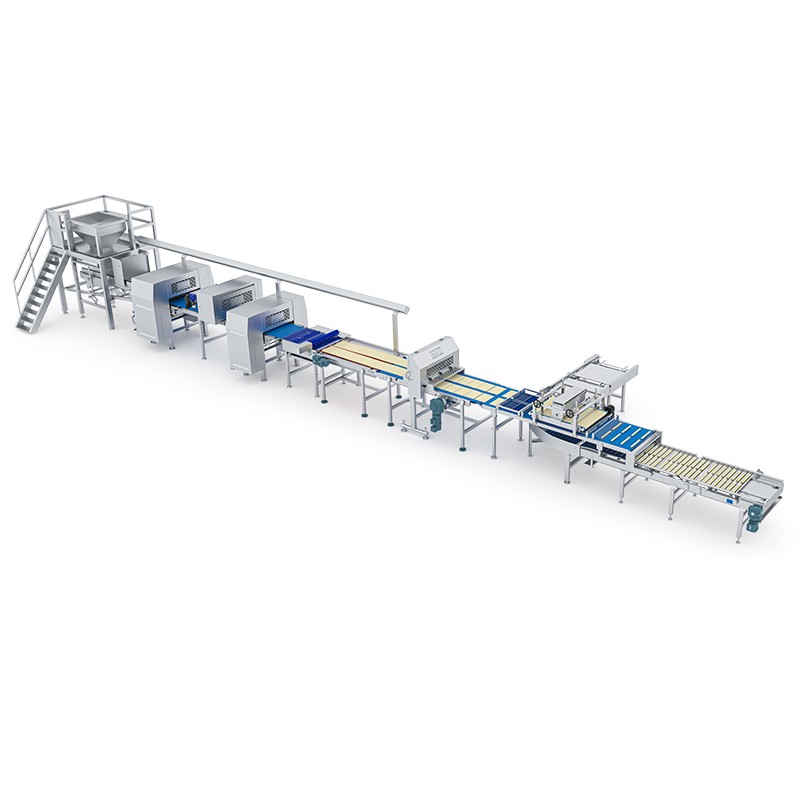
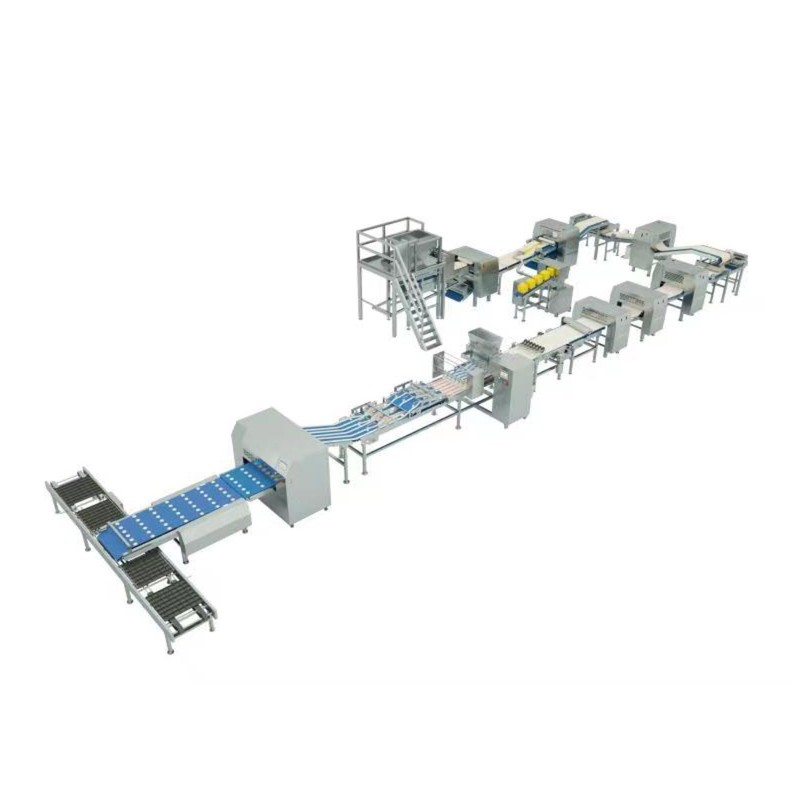
Egg Tart Shell Forming Machine
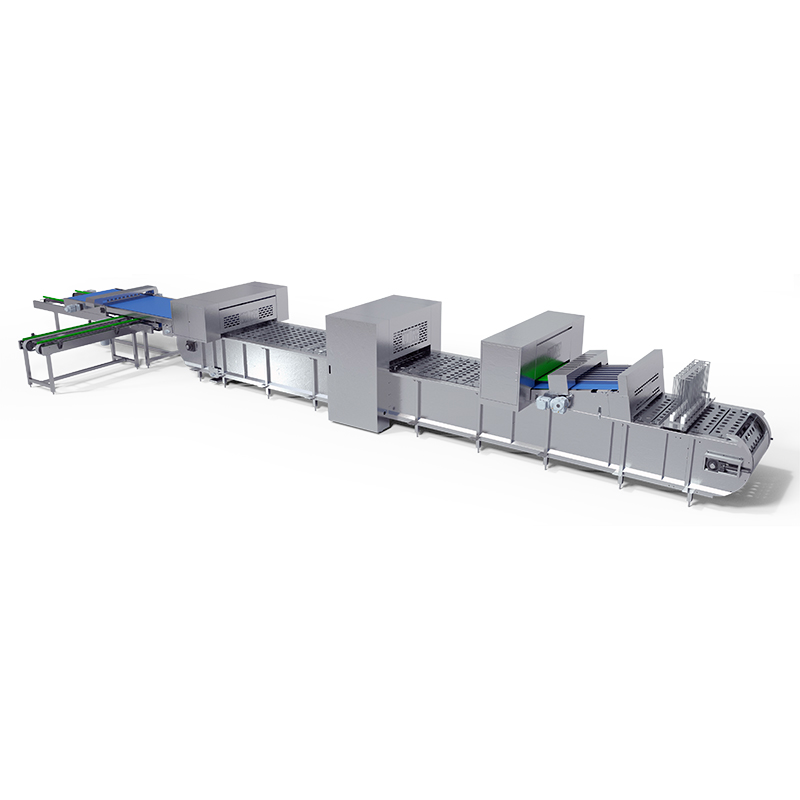
The egg tart shell forming machine takes a continuous strip of laminated pastry, cuts it to weight and presses each piece into a foil or paper cup. It runs 40 to 260 mm products at up to 20,000 pieces an hour, with 4, 6 or 8 row heads and a water-heated blocking head at 48–52 °C.
Product Overview
The egg tart shell forming machine takes a continuous strip of laminated pastry, cuts it to weight and presses each piece into a foil or paper cup. It runs 40 to 260 mm products at up to 20,000 pieces an hour, with 4, 6 or 8 row heads and a water-heated blocking head at 48–52 °C.
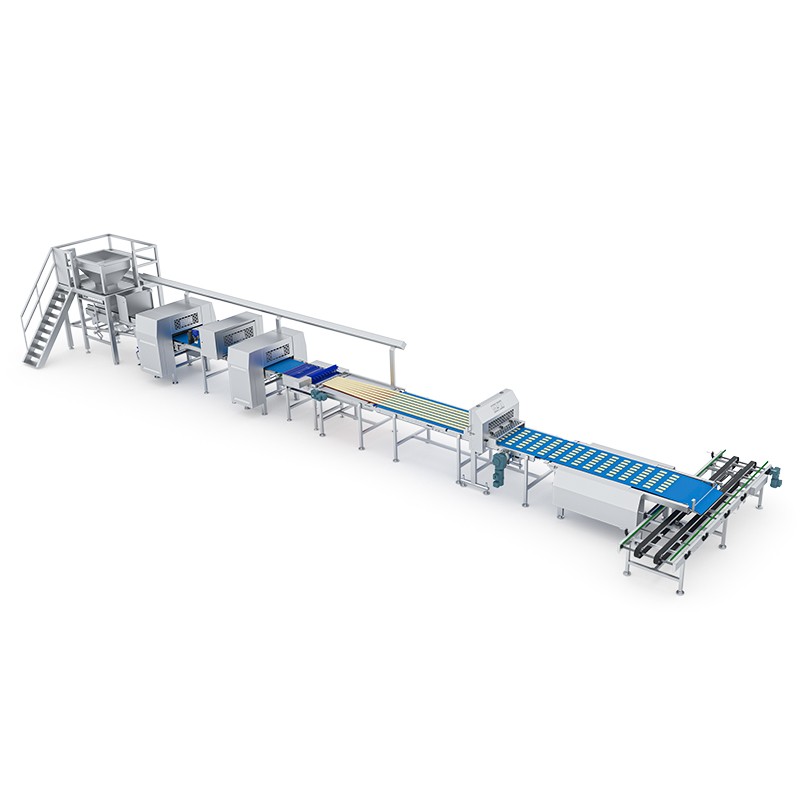
This is the section of an egg tart line that fixes cup diameter, wall thickness, rim shape and piece weight. Plants already running a sheeter and laminator take it as a standalone unit. Plants starting from flour usually buy it with the strip feeder and the denester, as one continuous section.
What happens inside the forming section
Six things run in sequence, and each one leaves a mark on the finished cup.
Denesting. A vacuum foil denester lifts one cup at a time from the magazine and sets it into the die. Vacuum is not a detail here. A cup that lands crooked jams the press, and clearing a jam costs far more than the second it saves.
Strip feeding. The UIM strip feeder draws the pastry sheet off the roller and presents it to the cutting station at constant tension. Feeders are matched to the pastry roller diameter, so the section can be specified against the sheeter you already have on the floor.
Cutting. A guillotine squares the strip into billets. Two things come out of this step: how much the billet weighs, and where it lands. Both carry straight through to the piece weight at the end of the line.
Blocking and crimping. A servo-driven press pushes the billet into the cup and forms the wall and rim. The blocking head is water heated and held at 48–52 °C ± 1, set against the moisture of the pastry dough. No material is trimmed in this step — the billet becomes the shell.
Demoulding. Formed shells lift clear of the tooling and leave the die.
Outfeed. Shells transfer to trays, to a panel rack, to an oven band, or straight into a freezer infeed.
Product Specifications
| Item | Value |
|---|---|
| Product diameter | 40–260 mm |
| Output at Ø40 mm | up to 20,000 pcs/h |
| Output at Ø260 mm | up to 5,200 pcs/h |
| Row configuration | 4, 6 or 8 |
| Line length | from 10.5 m |
| Machine size (L × W × H) | up to 18 × 2 × 1.85 m |
| Working width | 600–1200 mm |
| Working height | 850 mm |
| Clearance under conveyor | 250 / 500 / 800 mm |
| Punching heat | water heating, 48–52 °C ± 1 |
| Containers | foil, paper containers, metal baking trays, hoops, tins, indented baking trays |
| Outfeed | trays, panels, oven band, freezer infeed |
Capacity follows diameter, not the other way round
Piece size sets output. A 40 mm shell uses a fraction of the dough and die travel of a 260 mm one, which is why the same frame runs 20,000 an hour at one end of the range and 5,200 at the other. Row count compounds it: 4, 6 and 8 row heads change how many shells leave the press in one cycle.
Interpolating between those two endpoints gets you a number nobody can hold you to. Die area, not diameter alone, drives the cycle. Send the cup profile and we will calculate against it.
Heads, rows and changeover
Blocking and crimping heads are changed at the operator side by one person. No crane, no lifting gear, no second pair of hands. The 4 and 8 row units sit on wheels, so a unit can be pulled clear of the line for a mould change or a deep clean and pushed back into position.
Clearance under the conveyor is 250, 500 or 800 mm depending on frame height. That is the difference between a washdown that happens every shift and one that waits for a shutdown.
Containers and products it runs
Foils, paper containers, metal baking trays, hoops, tins and indented baking trays all run on the same press. What changes between them is the tooling and the denester magazine, not the machine.
On the product side: Portuguese egg tart shells, standard round shells, mini tarts, and pie or quiche bases up to 260 mm. Frozen shells run the same way — the only difference is where the outfeed sends them.
Standalone unit or part of a line
There are two ways to buy it.
Standalone. You already sheet and laminate. The forming section takes your strip and returns shells. This is the usual entry point for bakeries that have run a pastry line for years and want to lift output or hold weight without replacing the upstream.
As a section of a new line. Strip feeder, denester, forming, panning and freezing are specified together. This route makes sense while the dough recipe is still moving, because sheeting gap and lamination layers both show up in the forming result.
Either way the upstream requirement is the same: a continuous strip at consistent thickness, and a pastry roller diameter the feeder can be matched to. If your sheeter is older than the rest of the line, say so at the quotation stage — the feeder choice depends on it.
Options and tooling
- Moulds and cutting tools machined to your cup profile
- Feeder matched to your pastry roller diameter
- Outfeed configured for trays, panels, oven band or freezer
- Row count 4, 6 or 8
Wear parts — blocking heads, crimping heads, cutting tools, moulds — are quoted with the machine, so the replacement cost is visible before the order rather than after the first season.
Inspection before dispatch
Food contact parts and bought-in components are checked on arrival. The press is set with the mould for your product and run, then shell diameter, height, wall thickness and weight are measured against the sample you approved. Head temperature is verified inside the 48–52 °C band. Mould drawings and parameter records travel with the machine so a second unit can be set up the same way.
FAQ
Can it form paper cups as well as foil?
Yes. The denester handles foil, paper containers and indented trays. The magazine and the vacuum setting change; the press does not.
Do I need a complete production line to run it?
No. With a sheeter supplying strip, the forming section runs on its own. Panning, freezing and packaging are separate modules and can be added later without touching the forming unit.
How is piece weight kept consistent?
Through the guillotine, not the press. Billet weight and drop position are set at the cutting station, and the press forms that billet without removing material. When weight drifts, check strip feed tension and the knife first.
What is the 48–52 °C head temperature for?
It is the water temperature inside the blocking head, set against the moisture in the pastry. Too cold and the dough drags in the die; too hot and the fat starts to run. The band is narrow because the working window is narrow.
What diameters can it handle?
40 to 260 mm as standard. Outside that range the tooling becomes a custom job, and we quote it against your drawing rather than against the catalogue.
Who changes the heads, and how long does it take?
One operator, working from the operator side, with no lifting equipment. On the 4 and 8 row units the head can be changed with the unit pulled clear of the line. Time depends on row count, and we run the first change with your team during commissioning.
What do you need from us to quote?
Cup diameter, height, wall thickness, piece weight, dough type and target output per shift. A drawing or a sample shell beats a written description. Row count and tooling are then quoted together.