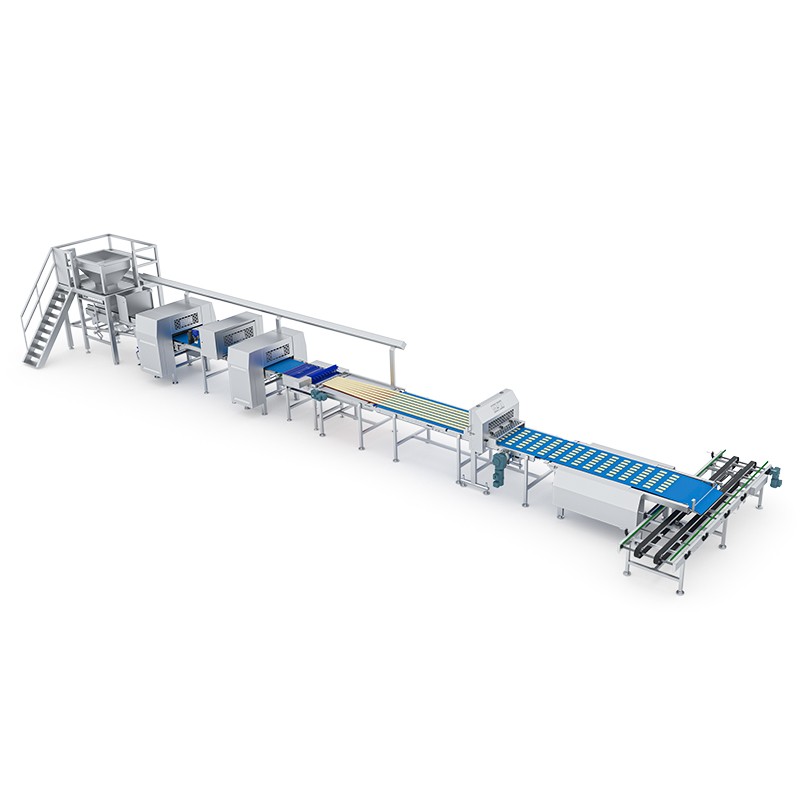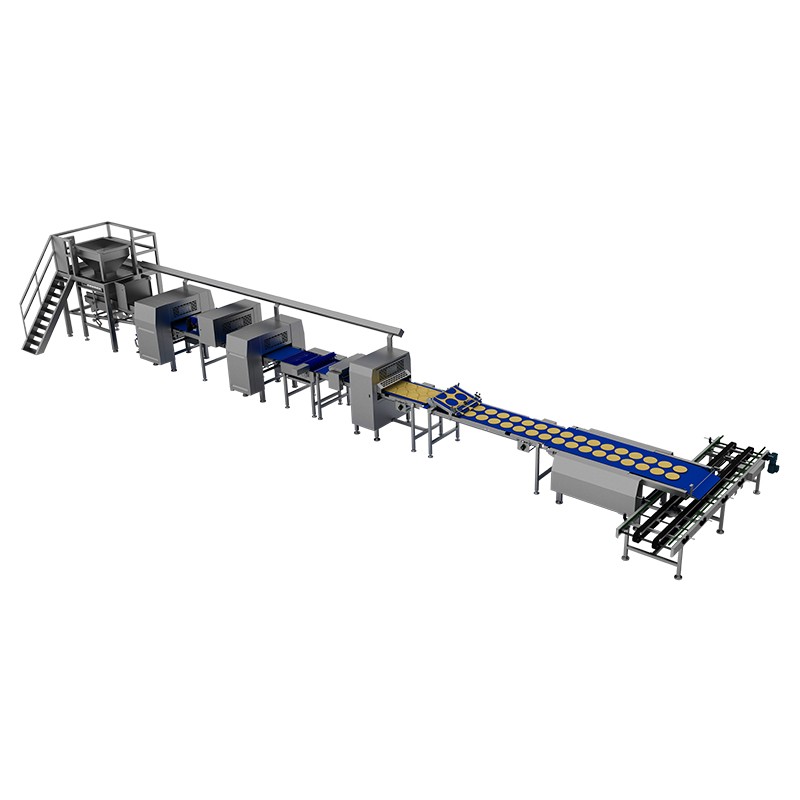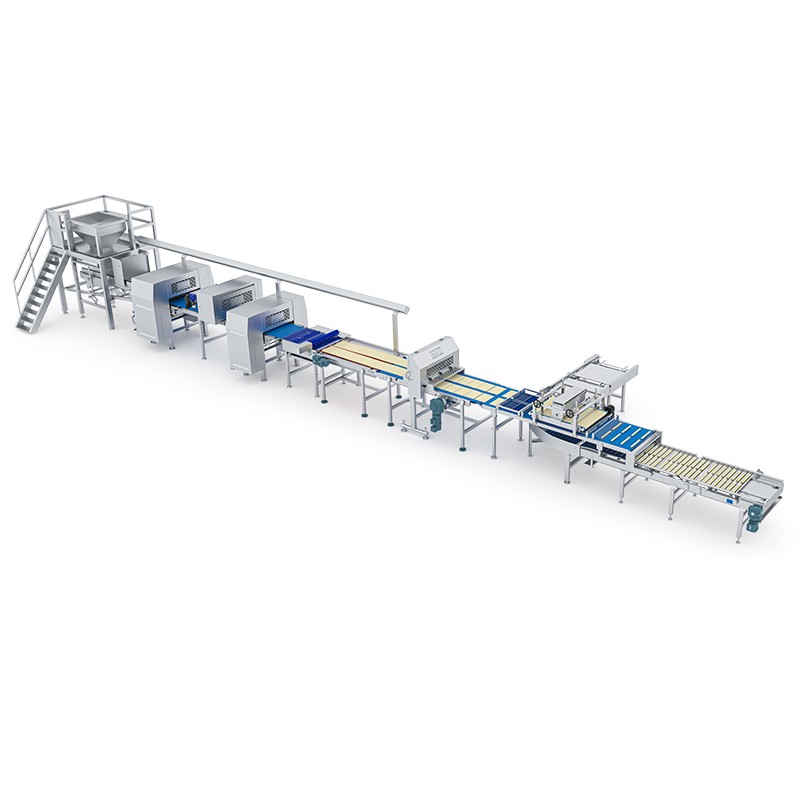
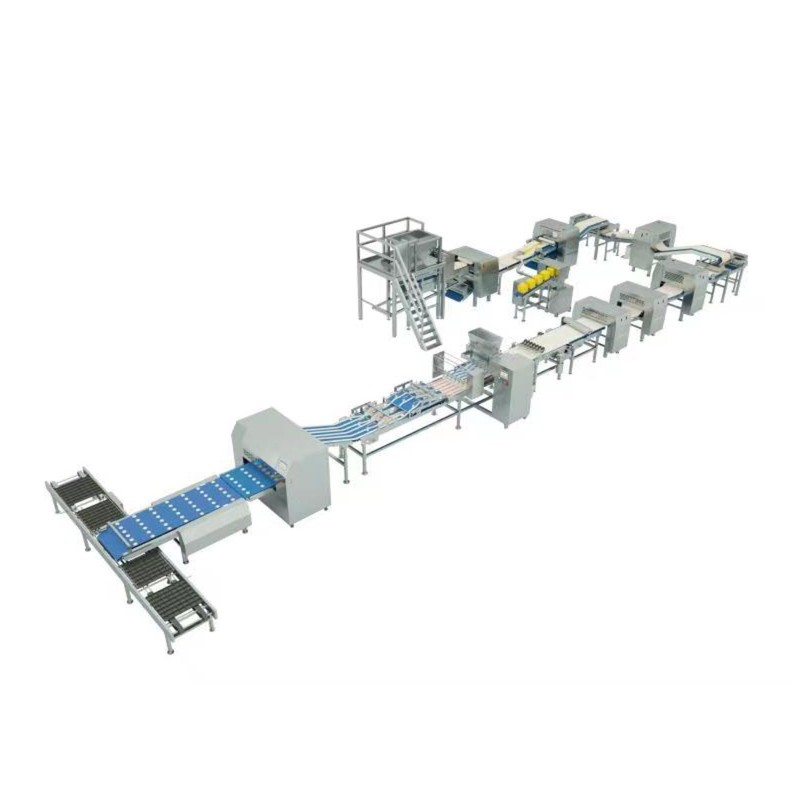
Sheeting Line
Automatic Industrial Laminated Dough Production Line
The laminated dough line runs 12,000-24,000 pcs/h on the standard build and 120,000-150,000 pcs/h on the automatic build, on a 600-1600 mm sheet width. A Siemens PLC with HMI stores recipes, and a fat pump sets butter width and thickness without build-up. 380V/60Hz, food-grade stainless steel.
Product Overview
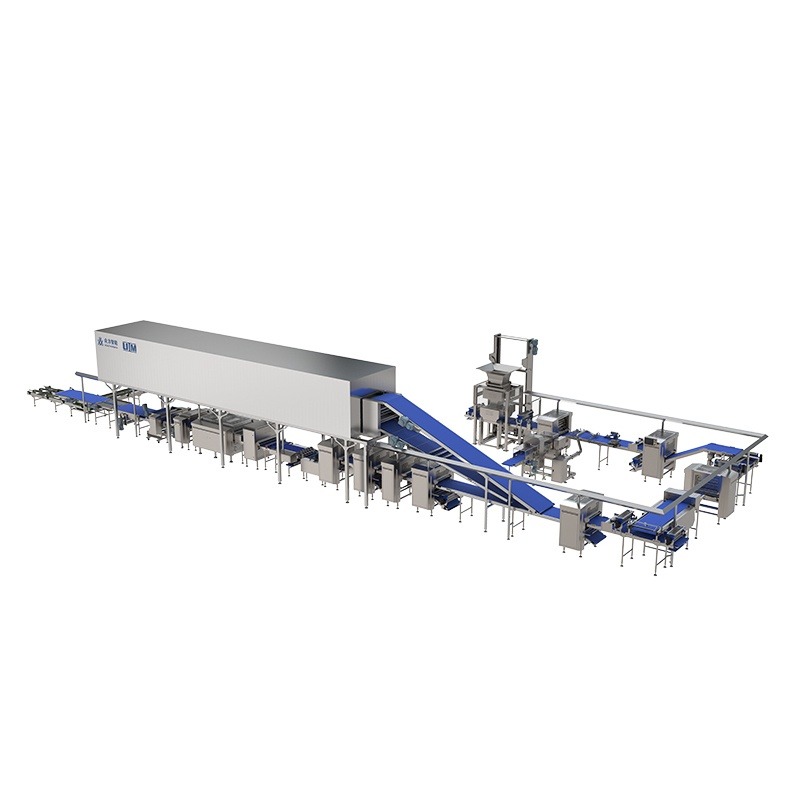
The industrial laminated dough production line is a continuous sheeting, butter lamination and folding system in the Sheeting & Lamination Lines category, built for industrial bakeries and frozen dough manufacturers producing croissants, Danish, puff pastry and filled pastries. Standard conveyor belt working widths are 600 mm, 800 mm, 1000 mm and 1200 mm, with equipment widths from 680 mm to 1280 mm and dough sheet widths up to 1600 mm on the automatic configuration. Capacity runs from 12000 to 24000 pieces per hour on the standard line, and up to 120000-150000 pieces per hour on the automatic line.
That throughput only holds if the dough survives the process. The line uses low-stress calendering, a low-temperature relaxation tunnel and a fat pump that lays butter in a uniform sheet, so the gluten network and the butter layers stay intact from the first pass to the dis-cutter. A bakery switching from manual bench work gets repeatable layer counts and product weight without adding skilled staff to the line.
Key Features
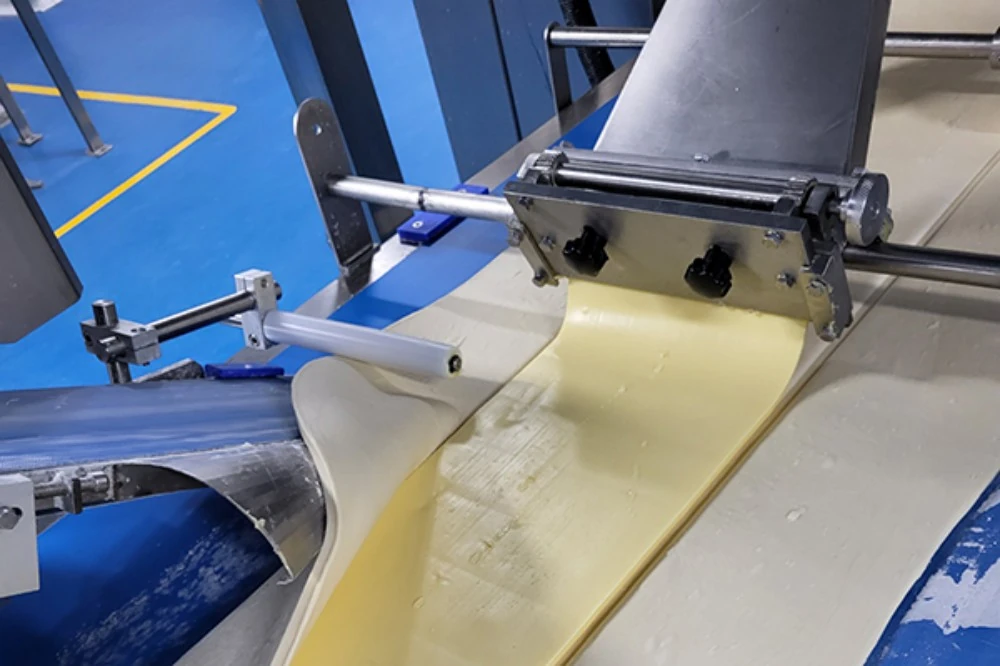
- Low-stress calendering system: the dough band is reduced to the required width and thickness without damage to its internal structure, so the dough stays soft and relaxed through the line.
- Fat pump with flanging device: butter is extruded as a thin sheet of a given width and thickness at the nozzle, then wrapped by both dough edges, so grease does not accumulate in one spot.
- Satellite rolling tower: the dough and butter are rolled repeatedly to the preset width and thickness before folding, which evens out the butter layer across the full band.
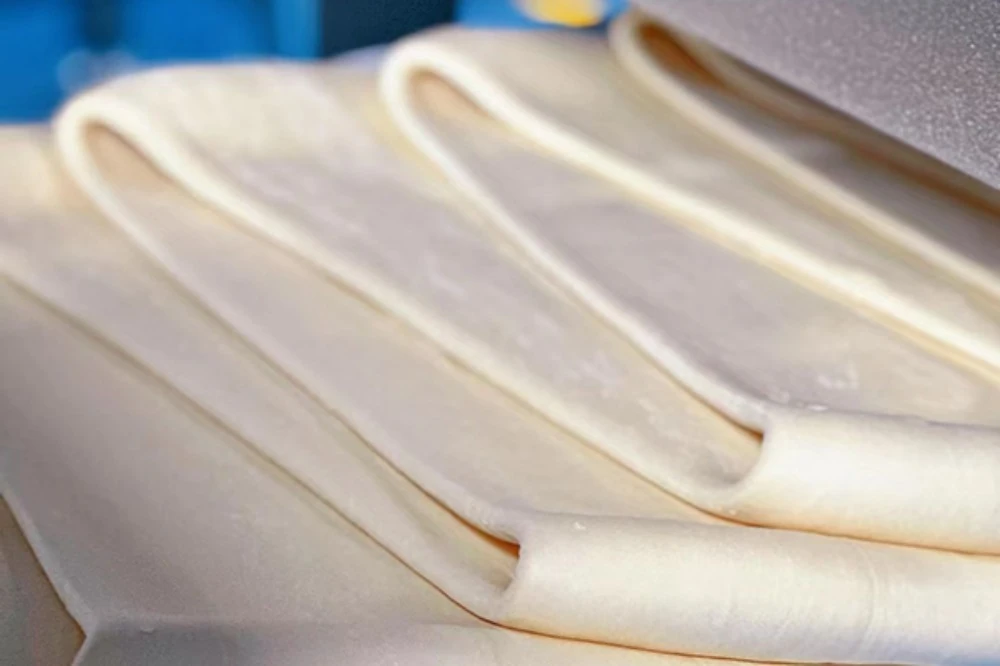
- Cut-stack folding: the stack is cut and folded so grease is distributed evenly at any position of the strip, and the number of folding layers is set to the recipe.
- Low-temperature relaxation tunnel: the band rests under controlled temperature with an anti-condensation device, so the surface does not dry and crack from direct blowing.
- Gauging roller: final thickness and width are set to the product and to the capacity requirement, with equipment widths from 680 mm to 1280 mm.
- Longitudinal dis-cutter: the finished band is split into narrow strips for filling, rolling or folding, which feeds the shaping modules downstream.
- Siemens PLC and servo drive: thickness and speed are adjusted from the HMI and recipes are stored, so a product changeover is a recall rather than a mechanical reset.
Product Specifications
| Model | industrial laminated dough production line (automatic configuration available) |
|---|---|
| Equipment capacity | 12000-24000 pcs/h (standard line); 120000-150000 pcs/h (automatic line) |
| Conveyor belt working width | 600 mm, 800 mm, 1000 mm, 1200 mm |
| Equipment width range | 680-1280 mm |
| Dough sheet width | 600 mm, 800 mm, 1000 mm, 1200 mm, 1600 mm |
| Dough sheet thickness | adjustable |
| Control system | Siemens PLC with HMI touchscreen, recipe storage |
| Drive | Siemens servo motor |
| Equipment material | food-grade stainless steel, FDA-compliant food-contact materials |
| Equipment voltage | 380V/60Hz |
| Folding layers | set according to customer recipe |
| Butter layer control | fat pump nozzle produces a given width and thickness with no accumulation |
| Resting system | low-temperature relaxation tunnel with anti-condensation device |
| Optional modules | proofer, freezing tunnel, filling machine, tray loading robot, metal detector, packaging line |
| Note | parameters are for reference and vary with dough, product weight and processing method |
Configurations & Options
| Belt working width 600 mm | entry configuration for smaller industrial bakeries and limited floor space; sets the maximum dough sheet width and therefore the hourly piece count. |
|---|---|
| Belt working width 800 mm | mid-range width for bakeries running croissants and Danish alongside puff pastry. |
| Belt working width 1000 mm | higher output for frozen dough manufacturers and central kitchens. |
| Belt working width 1200 mm | the widest standard conveyor, for high-volume lines feeding automatic shaping and panning. |
| Dough sheet width up to 1600 mm | automatic line configuration for large-scale laminated dough production. |
| Folding layer count | specified to the recipe, so a buyer orders the fold combination that matches their puff pastry or croissant lamination. |
| Intelligent control system | optional automatic adjustment of dough thickness and speed from the PLC. |
| Downstream modules | intermediate proofer, tunnel proofer, freezing tunnel, automatic filling machine, tray loading robot, metal detector and packaging line can be added to the line. |
Industrial Applications
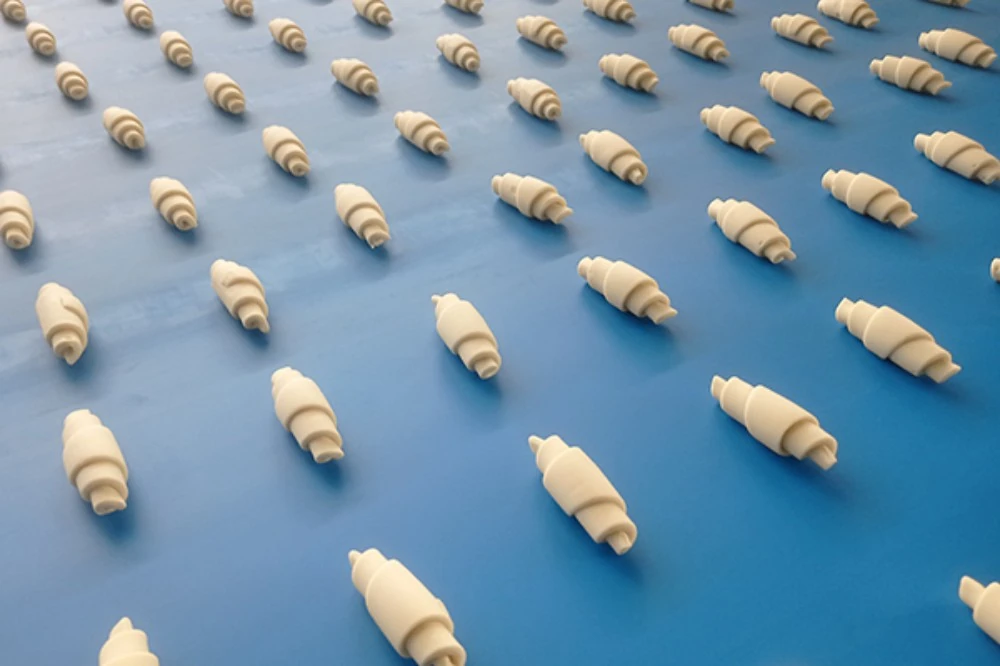
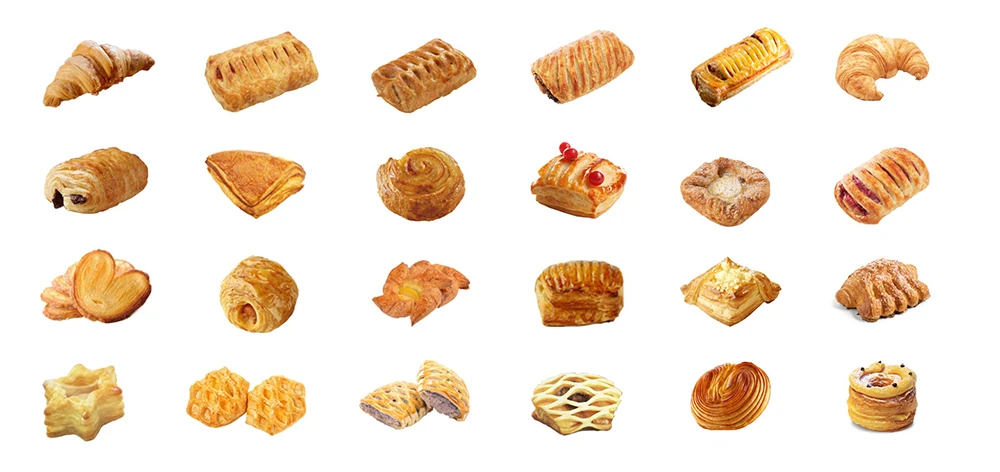
- Pastry lamination machine for croissant production: industrial bakeries and frozen dough plants run croissants, mini croissants and pain au chocolat; the satellite rolling tower and cut-stack folding hold a consistent layer count so the croissants expand evenly in the oven.
- Dough lamination line for puff pastry: puff pastry, palmier and puff sheet producers need clear layer definition; the fat pump lays a uniform butter sheet and the gauging roller sets the final thickness, so the bake lifts evenly across the sheet.
- Dough sheeting and laminating machine for Danish pastry: Danish and filled pastry makers use the longitudinal dis-cutter to split the band into strips for filling and rolling, which keeps weight and dimension consistent from piece to piece.
- Laminated dough line for frozen dough production: frozen bakery manufacturers integrate a freezing tunnel after forming, and the low-temperature relaxation tunnel keeps the dough from drying before it is frozen.
- Pastry lamination machine for char siew sou and egg tarts: bakeries producing char siew sou, egg tarts, durian custard pie and galette use the line for repeated sheeting and folding, then cut and shape on the same band.
Key Advantages
- Continuous operation without interruption: the line calenders, laminates and folds in one pass, so output is limited by the belt width rather than by bench handling between steps.
- Butter layer integrity: uniform nozzle extrusion plus satellite rolling means the butter stays in a continuous sheet, which is what produces visible flakiness and even expansion after baking.
- Lower labor dependency: automation removes manual sheeting and folding, so a line needs fewer skilled hands and produces the same weight and dimension on every shift.
- Reduced raw material waste: thickness control at the gauging roller and clean longitudinal cutting improve material utilization compared with hand-rolled dough.
- Modular expansion: the line is built from modules, so a buyer can add proofing, freezing, filling or packaging later instead of replacing the whole system.
- Hygienic design: food-grade stainless steel and washable construction shorten cleaning time between production runs and support the sanitation standard of an industrial bakery.
How to Choose the Right Configuration
| 600 mm belt width | suits smaller industrial bakeries and first-time automation; the deciding parameter is the hourly piece count you need against the floor space you have. |
|---|---|
| 800-1000 mm belt width | fits bakeries running several laminated products on one line; the wider belt raises capacity without changing the process. |
| 1200 mm belt width | for high-volume croissant and puff pastry plants feeding automatic shaping and panning; capacity is the deciding factor. |
| Automatic line with 1600 mm dough sheet width | for large frozen dough and OEM manufacturers; choose it when 12000-24000 pcs/h is not enough. |
| Optional intelligent control | for plants that change products often; automatic thickness and speed adjustment cuts setup time between recipes. |
| With freezing tunnel and proofer | for frozen dough manufacturers; without them, for bakeries that proof and bake in-house. |
Why Choose Us
- We quote the industrial laminated dough production line price against your product list and capacity target, not against a catalogue number, so the configuration matches the dough you actually run.
- As an industrial laminated dough production line manufacturer, we build the line from modules in our own workshop and commission it as a complete process, from dough mixing through packaging if required.
- Our engineering team works with you from process design to installation, commissioning and operator training, so the line starts on the recipe you bought it for.
- Spare parts and remote diagnosis support are available for global customers; the PLC allows fault diagnosis and parameter checks without a site visit.
- We supply as an industrial laminated dough production line supplier China-based and export-ready, with turnkey bakery solutions that include proofing, baking, cooling and packaging.
- Product changeover support covers cutting tools and forming modules, so one line can move between croissants, Danish and puff pastry as orders change.
Factory Strength
The line is assembled and tested in-house: frame and stainless steel structure, roller and calendering assemblies, fat pump and flanging device, electrical panels with Siemens PLC and servo drives, and the HMI software with recipe management. Each unit is run before packing to check dough thickness adjustment, belt tracking, folding sequence and fat output. Lines are exported to industrial bakeries, frozen bakery manufacturers, central kitchens and OEM bakery manufacturers worldwide, and we provide complete turnkey solutions from dough preparation through packaging.
Quality Control
Incoming stainless steel and food-contact materials are checked against the food-grade and FDA-compliant requirement before they enter assembly. In-process checks cover roller alignment, belt tension, fat pump output and folding sequence; each finished line is run-tested for thickness adjustment, speed control and PLC recipe recall before packing.
- Incoming material inspection: food-grade stainless steel and food-contact components checked on receipt.
- In-process checks: roller alignment, belt tracking, fat pump nozzle output and folding mechanism tested during assembly.
- Final run test: dough thickness and speed adjustment, PLC and HMI functions, fault diagnosis verified on the assembled line.
- Hygiene check: washable design and food-contact surfaces inspected before shipment.
Packaging & Delivery
Lines are packed for export in line with the module sizes and the belt widths ordered; modules are protected for sea freight and marked as requested. Port, trade terms, lead time and payment schedule are confirmed in the quotation, because they depend on the configuration and the destination.
- Packing: modules packed separately for container loading, with food-contact surfaces protected.
- Shipping: sea freight arranged to the buyer’s port; terms confirmed on the order.
- Lead time: confirmed at order, based on the configuration and options selected.
- Buyer to supply: delivery address, port, marks and any import documents required at destination.
FAQ
How does the industrial laminated dough production line keep the butter layer even?
The fat pump extrudes butter through a nozzle as a thin sheet of a set width and thickness, and the flanging device wraps the dough edges over it. Satellite rolling then spreads the butter and dough evenly before folding, which prevents fat from accumulating in one place.
What do the industrial laminated dough production line specifications mean for my capacity?
Capacity is set mainly by the conveyor belt working width: 600 mm, 800 mm, 1000 mm or 1200 mm, with equipment widths from 680 mm to 1280 mm. The standard line runs 12000-24000 pcs/h, and the automatic line with dough sheet widths up to 1600 mm runs 120000-150000 pcs/h.
Can I get an industrial laminated dough production line datasheet for my engineering team?
Yes. We issue the datasheet with the belt width, dough sheet width and thickness adjustment, PLC and servo specification, voltage and the optional modules selected, so your team can check utilities and floor space before ordering.
Can the pastry lamination machine for croissant production also run Danish and puff pastry?
Yes. Folding layer count is set to the recipe and stored in the PLC, and cutting tools and forming modules can be changed. The same line handles croissants, Danish pastries, puff pastry, palmier and filled pastries.
Is the dough lamination line for puff pastry suitable for frozen dough production?
Yes. A freezing tunnel can be integrated after forming, and the low-temperature relaxation tunnel with its anti-condensation device keeps the dough from drying or cracking before freezing.
What is the industrial laminated dough production line price?
Price depends on belt width, the number of folding stations, the control option and downstream modules such as the proofer or freezing tunnel. Send your product list and target output and we will quote the configuration that fits.
What is your MOQ and lead time for an order?
We build to order, so MOQ and lead time are confirmed in the quotation once the configuration is fixed. Lead time depends on the modules and options selected.
Do you offer OEM support and spare parts for export buyers?
Yes. We support OEM requirements and supply spare parts for exported lines. Remote diagnosis is available through the PLC for fault checks and parameter support.
How is the line packed and shipped?
Modules are packed separately for container loading with food-contact surfaces protected. Port, trade terms and payment schedule are confirmed on the order, and the buyer supplies the delivery address, port and shipping marks.